Unequal Value: How Pearson Prices Neighbourhoods
- The airport compensated some households with higher-value Visa gift cards than others for the same noise harm.
- Blue-collar neighbourhoods closest to the airport received lower amounts than more affluent areas farther away.
- Compensation appears to track who has influence, not who has exposure.
- When money is used this way, it is not “community engagement” — it is pricing out which communities are worth appeasing.
Toronto has one of the most unequal noise footprints in Canada. This page documents a specific episode where households under Pearson’s flight paths were offered different compensation amounts for the same disruption. The documents below show how payments were structured, how residents responded, and how the airport tried to frame these payments as “goodwill”.
Exhibit A – GTAA Letter Sent With the Prepaid Visa Card
The first document is the GTAA letter that arrived with the prepaid Visa card. It frames the payment as a one-time gesture linked to runway work, without addressing the wider pattern of noise and unequal compensation across neighbourhoods.
Exhibit B – Community Letter Questioning Unequal Compensation
The second document is the community letter from Daryl Henderson to GTAA’s Noise Management lead, Gijs. It asks why some households received higher-value cards than others for the same disruption and requests clear criteria for how amounts were decided.
Exhibit C – Response from GTAA Noise Management (Gijs)
The third document is Gijs’s response on behalf of GTAA Noise Management. It acknowledges the concerns and the payment, but does not resolve the underlying equity questions raised in the community letter.
Exhibit D – $200 Gift-Card Package Sent to an Affluent Neighbourhood
In 2022, a resident in a more affluent area under Pearson’s east–west runways received a registered letter from GTAA containing a $200 prepaid Visa card as compensation for construction-related noise on runway 06L/24R. The materials below show how this payment was packaged and delivered.
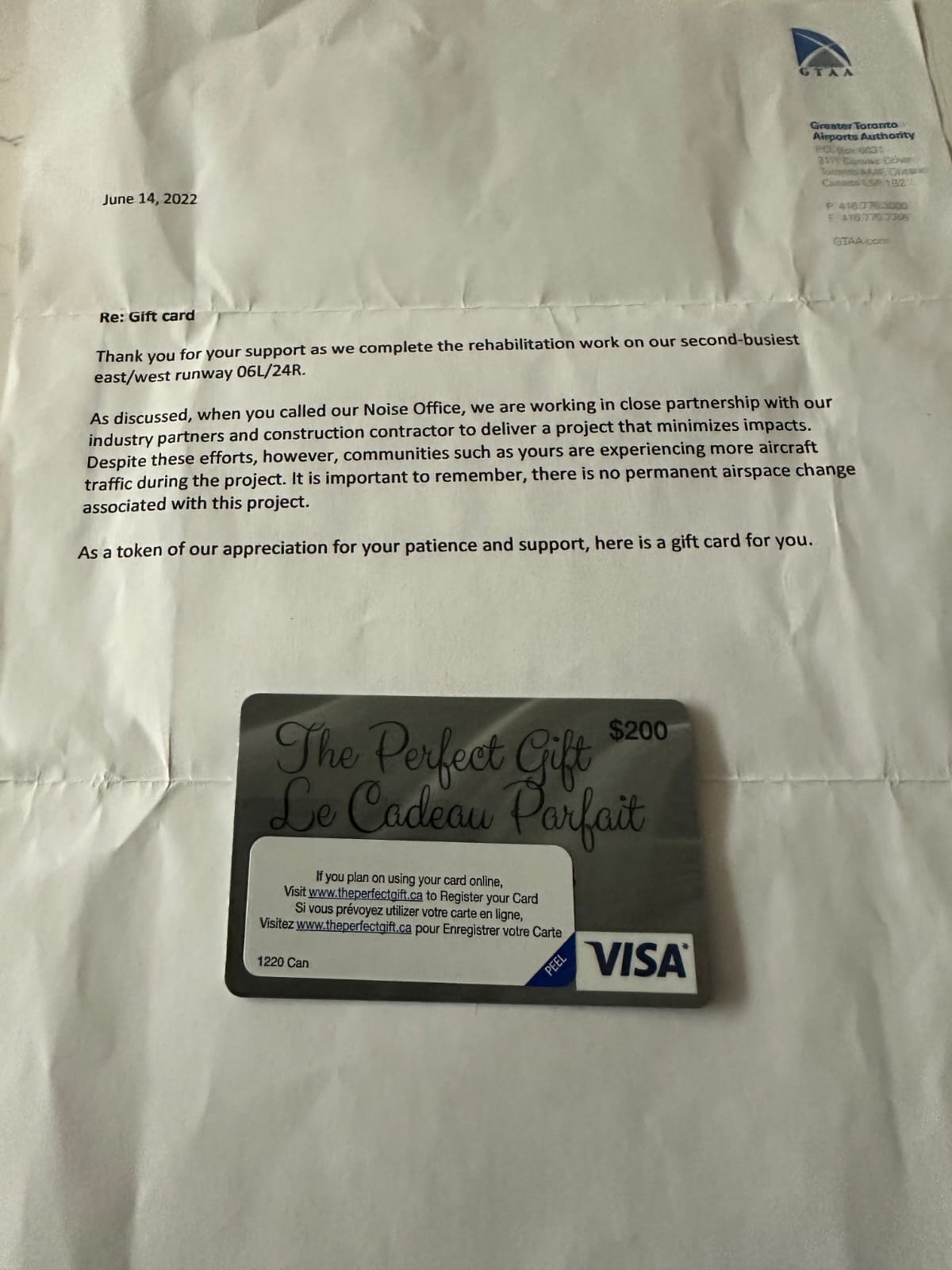
Residents in blue-collar communities closer to the runway system report receiving significantly lower amounts (for example, gift cards of approximately $100 per household) despite experiencing higher and more frequent exposure. This contrast is one of the clearest examples of how Pearson’s compensation practices appear to value neighbourhoods differently.
Template: Write About Unequal Compensation and Complaint Barriers
Use the tool below to generate a letter you can send to elected representatives or oversight bodies about both unequal compensation and the barriers to filing noise complaints. Adjust the text to match your role and audience, then copy and paste it into your email or document.
Fill in your details and the person or office you are writing to. Then copy the letter and paste it into an email, Word document, or submission form.
Turn This Evidence Into a Formal Record
Generate a formal letter you can adapt for MPs, councillors, ombuds, unions, or media.
Why This Matters for Equity and Health
This is not simply about one gift-card program. It is about how institutions decide which communities receive acknowledgement and which are quietly expected to absorb the harm. When compensation and complaint systems reward influence rather than exposure, noise becomes yet another way of sorting people by social class.
Blue-collar communities closest to Pearson are already living with lower flight altitudes, higher night-time disturbance, and elevated exposure to pollution. Giving these households lower-value compensation while offering more to affluent areas sends a clear message about whose health is taken seriously.
Pearson operates on federal land under a Ground Lease with Transport Canada. When compensation and complaint systems deepen inequality instead of correcting it, it is no longer credible for the federal landlord to look away. Enough is enough; communities closest to the runways must be treated as equal in law and in health, not as expendable buffers for airport growth.
Where to Direct This Evidence
Use the tools below to send this evidence to the relevant federal, provincial, municipal and public-health decision-makers. These shortcodes pull the same “Where to Direct” cards used across the Evidence Hub so that contacts stay synchronized.
Pearson Accountability Alliance
Independent Environmental & Public Health Research for Toronto Pearson Communities.