
The Truth About NEF: Why Pearson Uses a 1970s Model to Hide 2026 Noise
- NEF is a 1970s prediction tool for land-use planning, not a modern health standard.
- It averages 24 hours of sound, hiding night-time spikes and event frequency that damage sleep and health.
- Transport Canada intended NEF to be reviewed about every 5 years. At Pearson, contours have been effectively frozen since 2000.
- The GTAA Ground Lease requires compliance with current environmental and health laws — NEF does not override those obligations.
- Real monitoring (e.g., Acacia Park) shows much higher night noise than the old NEF contours suggest.
What “NEF” Stands For
NEF means Noise Exposure Forecast.
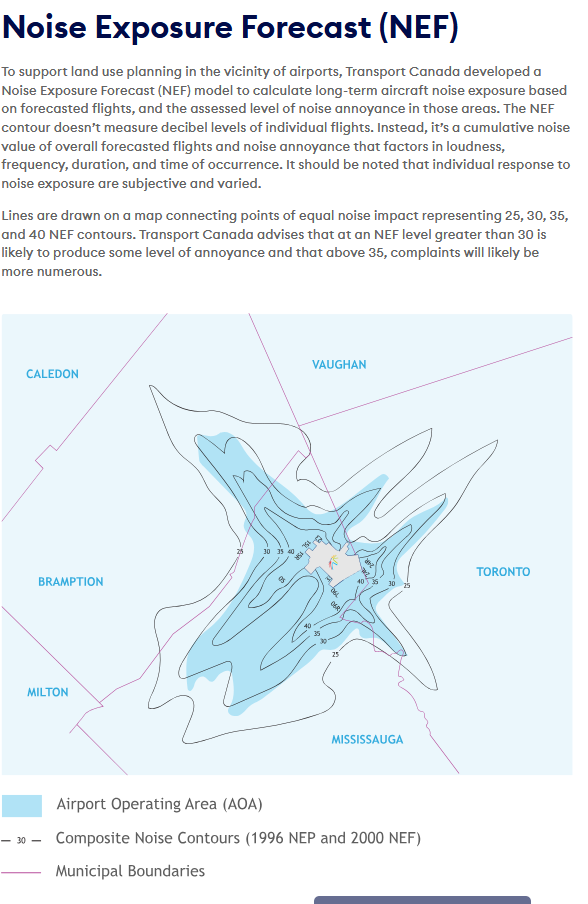
NEF is a legacy noise-modelling system developed by Transport Canada in the 1970s to estimate long-term aircraft noise exposure around airports. It does not measure noise. Instead, it generates a mathematical prediction using average daily movements and assumed fleet mixes.
The final output is a set of contour lines (e.g., NEF 25, 30) drawn on a map. These contours were intended to guide municipal land-use decisions — not to set health-based limits for 24/7 mega-hub operations.
Why the NEF System Is No Longer Appropriate
In modern operations, NEF fails because it:
- does not measure real noise, only predictions;
- does not show night-time intensity or event frequency;
- does not update with annual traffic changes or new fleet mixes;
- does not reflect cargo growth and 24-hour operations;
- is incompatible with health-based standards (like WHO guidelines) used worldwide.
The NEF Averaging Problem: Why It Hides Real Harm
NEF is an energy-averaged metric. It takes all the sound energy from aircraft over 24 hours and compresses it into a single number. This hides the very thing that matters most to human health: peaks and clusters of noise.
Imagine someone pours a 10-litre bucket of water over your head all at once at 2:00 a.m. You are soaked and awake. Now imagine they pour the same 10 litres drop by drop over an entire day. NEF treats both situations as exactly the same.
The human heart and nervous system do not “average” noise. They react to each peak event with stress hormones. NEF hides these peaks.
1970s NEF Model vs. 2026 Reality
| Feature | 1970s NEF Model | 2026 Reality |
|---|---|---|
| Data Source | Mathematical predictions | Real-time acoustic monitoring and noise logs |
| Traffic Profile | Mostly daytime operations; simpler schedules | 24/7 global hub with concentrated night-time peaks and cargo banks |
| Health Basis | Subjective “annoyance” thresholds | WHO sleep & cardiovascular guidelines; documented medical harms |
| Update Cycle | Intended every 5–10 years | No meaningful NEF update at Pearson in over 20 years |
How Canada Compares Globally
Other countries have moved far beyond the NEF system toward metrics that reflect human health and night-time sensitivity.
| Region | Metric | Why it’s better |
|---|---|---|
| Canada | NEF | Legacy planning tool. Health focus is minimal and outdated. |
| Europe (EU) | Lden | Includes +10 dB penalty for night noise; built around sleep and long-term exposure. |
| WHO (2018) | Lnight | Strict sleep protection guidelines; recommends ≤ 45 dB at night for aircraft noise. |
| Australia | N70 | Counts the number of loud events (e.g. “Number Above 70 dB”). Easy to understand and enforce. |
What the GTAA Ground Lease Requires
The GTAA Ground Lease requires compliance with “Applicable Environmental Laws” (Section 8.02.01) and a duty to “minimize or prevent Environmental Damage” (Section 8.02.03).
NEF is not an environmental law. It is a planning model. Meeting a 1970s planning guideline does not exempt the airport from its modern duty to prevent environmental and health damage under current federal and provincial law.
The Human Cost
NEF is a mathematical equation; sleep deprivation is a medical condition. The WHO 2018 Environmental Noise Guidelines describe aircraft noise as a public-health threat. Repeated exposure is associated with cardiovascular disease, hypertension, and cognitive impairment in children.
When Pearson relies on frozen NEF contours while running 24/7 operations, the model systematically underestimates the lived experience of communities and the medical risk imposed on them.
Evidence Files and Data
The resources below compare modelled NEF contours with real measured noise and with the GTAA’s own contractual obligations.
Acacia Park Community Noise Monitor – 2025 Summary & Data
Real measured levels and night events that far exceed what the frozen NEF contours suggest.
GTAA Ground Lease – Full Agreement (Local PDF Copy)
The full contract governing GTAA’s obligations. A separate “Key Provisions & Breaches” analysis will be
published once that file is ready.
Take Action: Demand Modern Standards
The use of the 1970s NEF system allows the airport to claim “compliance” while ignoring real health impacts. We must demand that the Federal Government update noise metrics to match modern science.
Step 1: Who to Contact
This is a federal policy issue. Contact the Minister of Transport and your MP.
To:
mintc@tc.gc.ca (Minister of Transport)
CC: Your Member of Parliament – look up your MP here.
Step 2: Copy & Send This Letter
Subject: Urgent: Replace Obsolete NEF Noise Metrics at Toronto Pearson
To the Minister of Transport,
I am writing to demand that Transport Canada abandon the obsolete Noise Exposure Forecast (NEF) system currently used at Toronto Pearson International Airport and replace it with modern, health-based noise metrics.
The NEF system dates back to the 1970s. It relies on 24-hour averaging that hides the frequency and intensity of night-time noise events. It is completely disconnected from modern medical science, including the WHO 2018 Environmental Noise Guidelines, which prioritize sleep protection and cardiovascular health.
Furthermore, the NEF contours at Pearson have not been meaningfully updated in over 20 years, despite the airport’s transformation into a 24/7 mega-hub. This means land-use planning and health decisions are being made based on data that is decades out of date.
I am requesting that you:
- Direct the GTAA to stop using expired NEF contours to justify current operations.
- Adopt modern metrics (such as Lnight and N70 “Number Above”) that accurately measure sleep disturbance and event frequency.
- Enforce the Ground Lease requirement to prevent “Environmental Damage,” rather than accepting NEF compliance as a substitute for health protection.
My community’s health should not be managed using a 50-year-old planning tool. It is time to catch up to the rest of the world.
Sincerely,
[Your Name]
[Your Address / Postal Code]
Enough is enough. Join the Alliance.
Governments and regulators are counting on residents to stay isolated and silent. By joining the Pearson Accountability Alliance, you help build the numbers needed to demand oversight.
Documents / Links
Transport Canada – GTAA Ground Lease Agreement (Official Source)
Privacy / Sanitization Notice.
The documents published on this page have been sanitized to protect personal information.
Pearson Accountability Alliance
Independent Environmental & Public Health Research for Toronto Pearson Communities.