Noise Monitoring at Pearson
Independent documentation of outages, invalid readings, transparency gaps, and reliability issues affecting Pearson’s public noise-monitoring network.
Separate from Pearson’s noise-monitoring network, reliability issues affecting the public WebTrak flight-tracking portal are documented on a dedicated evidence page.
Toronto Pearson’s operator, the Greater Toronto Airports Authority (GTAA), states that it has been “monitoring noise in neighbouring communities and areas under flight paths since the 1970s” and that there are currently 25 active Noise Monitoring Terminals (NMTs) distributed around the airport. These monitors feed into the Airport Noise and Operations Monitoring System (ANOMS).
Status of information requests
On January 9, 2026, Pearson Accountability Alliance submitted two formal requests for detailed noise-monitor outage logs covering the Toronto Pearson NMT network:
- A joint email request to GTAA and NAV CANADA asking for a complete log of all NMT outages, faults, and maintenance events.
- A formal Access to Information (ATI) request to Transport Canada requesting records related to NMT availability, outages, and configuration changes.
On February 24, 2026, Pearson Accountability Alliance emailed the GTAA Noise Management Office documenting several issues affecting the public monitoring system, including:
- the Pond Street NMT outage; and
- approximately 20 days of invalid fixed readings at the Marvin Heights Public School monitor.
On March 9, 2026, a follow-up email was sent noting that the Pond Street monitor was still offline.
Based on community screenshots, the Pond Street monitor appears to have remained offline from the morning of February 18, 2026 until sometime after midday on March 12, 2026 — a downtime of approximately 22 days.
On March 15–16, 2026, a further Pond Street interruption was documented. Based on publicly available monitoring data, the monitor stopped reporting at approximately 08:00 on March 15 and appears to have been restored shortly after 09:00 on March 16. This incident was also placed on the record with GTAA.
On March 20, 2026, the GTAA provided a written response confirming certain outage events, including the Pond Street and Tobias Park failures, but did not provide system-wide outage logs, uptime statistics, or performance metrics.
On March 19, 2026, community screenshots documented the Tobias Park monitor offline as of 17:00. Additional observations indicate that the outage continued into March 20, with the monitor appearing to return online sometime after 10:15 on March 20, 2026.
On March 23, 2026, sequential community screenshots documented an apparent system-wide outage affecting all published NMTs, with all monitors shown offline from approximately 13:05 onward while aircraft activity remained visible on the public interface.
Community monitoring indicates that the Brampton Fire Station #209 NMT outage / non-reporting period was continuous from at least June 20, 2026 until the monitor was observed back online at some point on July 13, 2026. Screenshots from June 20, June 21, and June 22 show the monitor offline or not reporting while surrounding monitors continued to display readings.
This represents a continuous public reporting gap of approximately 23 days, subject to GTAA confirmation of the exact start and restoration times. The cause of the failure, whether any noise data were lost, and whether the outage will be publicly disclosed remain unknown unless and until GTAA provides a formal explanation.
If information is received from GTAA, NAV CANADA, or Transport Canada, this page will be updated to publish the records and provide a detailed timeline of monitor availability.
Evidence documents — January 9 outage-log request, February 24 email, March 9 follow-up, March 16 Pond Street outage email, March 19–20 Tobias Park outage email, March 20 GTAA response, March 23 system-wide outage screenshots, June 20 Brampton Fire Station screenshot, June 21 Brampton Fire Station screenshot, June 22 Brampton Fire Station screenshot
Until detailed outage records are disclosed, the absence of those logs — and the lack of response to documented outage reports — should itself be understood as part of the public record.
GTAA refusal to disclose NMT performance data
On February 9, 2026, the GTAA responded to a request from Pearson Accountability Alliance seeking operational and noise-monitoring information related to Toronto Pearson’s monitoring network.
In its written response, the GTAA stated that information such as general operational datasets, flight activity, NMT performance metrics, and system-level monitoring information would not be disclosed.
The GTAA stated that general operational datasets, flight activity, and NMT performance metrics are “confidential and not subject to release,” that “no additional operational or system level data is available for disclosure,” and that it “will not authorize or participate in any private or unsolicited external audit of operational activities.”
This means the public does not have access to basic performance information for the system used to characterize aircraft noise exposure in surrounding communities.
Because GTAA does not publish monitor uptime statistics, outage logs, or performance metrics, the public has no independent way to verify whether the monitoring network was functioning during the periods used to generate official noise statistics.
Evidence document: GTAA response to request for operational and noise-related information (February 9, 2026)
GTAA response regarding Pond Street and Tobias Park outages
On March 20, 2026, the GTAA provided a written response regarding the Pond Street and Tobias Park NMT outages.
In that response, the GTAA confirmed that:
- The Pond Street NMT outage began on February 18, 2026 and was attributed to a power-related issue, with service restored on March 12, 2026 following an on-site technician visit.
- The Tobias Park NMT went offline on the evening of March 19, 2026 and was remotely reset, with functionality confirmed as of 11:00 on March 20, 2026.
- Noise Monitoring Terminals are maintained and monitored by a third-party vendor.
However, the GTAA also reiterated that it does not disclose broader system-level monitoring data, including outage logs, uptime statistics, or performance metrics.
The GTAA stated that “no additional operational or system-level data is available for disclosure,” including general operational datasets and monitoring system performance information.
This means that while individual outages may be acknowledged after the fact, the public still has no access to the records needed to independently assess the reliability of the monitoring network as a whole.
Evidence document: GTAA response regarding Pond Street and Tobias Park NMT outages (March 20, 2026)
What the GTAA says about noise monitoring
According to the GTAA, NMTs are used to obtain objective data and assess aircraft noise levels. NMTs are one source of information that feeds into ANOMS, which correlates noise events with aircraft operations to create “Aircraft Noise Events”.
- “25 active Noise Monitoring Terminals (NMTs) in neighbourhoods around the airport.”
- Noise events are measured against a sound level threshold:
- 65 dBA from 06:30 to 23:59
- 60 dBA from 00:00 to 06:29
- Noise events must last at least five seconds to be recorded.
- Recorded noise events are then checked against flight operations to flag “Aircraft Noise Events”.
- Pearson is federally regulated and “not bound to any municipal noise by-laws,” and there is no maximum legal noise limit; instead, the GTAA points to “noise abatement procedures” and “land use planning” as its main tools.
On paper, this sounds like a robust, science-based system. In practice, the reliability and transparency of the underlying network remain open questions.
Noise-monitoring infrastructure around Pearson
The GTAA publishes a map of NMT locations distributed around Pearson. These monitors are presented as a permanent, reliable network that has been operating since the 1970s. However, the GTAA does not publish:
- Uptime / availability statistics for each monitor;
- Historical outage logs (dates, durations, and causes);
- Maintenance or calibration records; or
- Any formal trigger for public notification when a monitor goes offline.
This page documents the infrastructure that exists, along with the reliability failures that affected communities have been reporting.
Current Noise Monitoring Terminals (NMTs)
The following table lists the NMTs currently published by the GTAA.
| Monitor | Neighbourhood / Site | Primary flight paths monitored |
|---|---|---|
| Acacia Ave. NMT | Acacia Avenue / Acacia Park area | Directly under 24L/06R and 23/05 path |
| West Humber Collegiate Institute NMT | West Humber Collegiate Institute (Etobicoke North) | Arrivals and departures along northern corridors |
| Eriksdale Ave NMT | Eriksdale Avenue (Etobicoke Centre) | Approach and departure tracks for east–west operations |
| Garnetwood Park NMT | Garnetwood Park (Mississauga East) | South/east corridors |
| James S. Bell Public School NMT | James S. Bell Junior Middle School (Etobicoke / Long Branch) | South corridors over the lakeshore communities |
| NAV CANADA Pond Street NMT | NAV CANADA / Pond Street area (Airport Corporate Centre) | Mixed arrivals/departures near the airport campus |
| Dearbourne Park NMT | Dearbourne Park (Brampton South) | Northwest arrival streams |
| Grenoble Public School NMT | Grenoble Public School (Brampton Central) | North–south traffic over Brampton |
| New Life Community Church NMT | New Life Community Church (Mississauga Malton) | Intense operations over Malton residential area |
| Marvin Heights Public School NMT | Marvin Heights Public School (Mississauga Malton) | Night-time arrivals and departures over Malton |
| BraeBen Golf Course NMT | BraeBen Golf Course (Mississauga Heartland) | High-altitude overflights and vectoring |
| South Fletchers Sportsplex NMT | South Fletchers Sportsplex (Brampton West) | West of airport; mixed traffic |
| Peel Village Golf Course NMT | Peel Village Golf Course (Brampton) | East–west paths over Brampton |
| Brampton Fire Station #209 NMT | Brampton Fire Station #209 (Brampton East) | Concentrated corridors over eastern Brampton |
| Meadow Glen Park NMT | Meadow Glen Park (Mississauga Meadowvale) | Northwest flight patterns |
| Richview Ambulance Station NMT | Richview Ambulance Station (Etobicoke Richview) | Major corridor for 24R/06L operations |
| Blackfriar Park NMT | Blackfriar Park (Etobicoke North) | North Etobicoke flight paths |
Selected 2026 NMT reliability issues
| Date | System / Monitor | Observed issue | Status based on available evidence |
|---|---|---|---|
| Jan 2026 (~20 days) | Marvin Heights Public School NMT | Readings appear locked between roughly 60–80 dB | Apparent monitor malfunction producing invalid data |
| 18 Feb 2026 | Pond Street NMT | Monitor appears offline before noon | Beginning of documented outage period |
| 24 Feb 2026 | PAA → GTAA | Email sent documenting multiple monitoring issues | No reply received |
| 9 Mar 2026 | PAA → GTAA | Follow-up email noting Pond Street still offline | No reply received |
| 12 Mar 2026 | Pond Street NMT | Monitor appears to return to service | Approximate outage length: 22 days |
| 15–16 Mar 2026 | Pond Street NMT | Monitor stopped reporting at approximately 08:00 on March 15 and was restored shortly after 09:00 on March 16 | Documented outage based on community monitoring and email placed on record with GTAA |
| 19–20 Mar 2026 | Tobias Park NMT | Monitor shown offline as of 17:00 on March 19 and appears to have returned online sometime after 10:15 on March 20 | Documented outage based on community screenshots and public monitoring data |
| 23 Mar 2026 | All NMTs | All published monitors simultaneously shown offline from approximately 13:05 onward during active operations | Apparent system-wide outage based on sequential screenshots |
| 20 Jun–13 Jul 2026 | Brampton Fire Station #209 NMT | Continuous outage / non-reporting period. Screenshots from June 20, June 21, and June 22 show the monitor blank or inactive while surrounding NMTs continue to display readings; the monitor was observed back online at some point on July 13. | Documented continuous public reporting gap of approximately 23 days, subject to GTAA confirmation of the exact start time, restoration time, cause, and data consequences. |
Monitor-specific evidence summaries
NAV CANADA Pond Street NMT – February–March 2026 outage
The Pond Street Noise Monitoring Terminal appears to have been offline from the morning of February 18, 2026 until sometime after midday on March 12, 2026, for a total outage of approximately 22 days.
Community screenshots captured on February 18, February 19, February 24, and March 9 show the monitor absent or non-reporting while other monitors remained visible on the GTAA WebTrak / noise-monitoring map. Despite the duration of the outage, no public explanation or outage notice was observed during this period.
On February 24, 2026, Pearson Accountability Alliance emailed GTAA requesting clarification about the Pond Street outage and invalid fixed readings at Marvin Heights Public School. No response was received. On March 9, 2026, a follow-up email was sent specifically noting that Pond Street was still offline. Again, no response was received.
In addition to the February–March outage, a further interruption was documented between March 15 and March 16, 2026. Based on publicly available monitoring data, the Pond Street monitor stopped reporting at approximately 08:00 on March 15 and appears to have been restored shortly after 09:00 on March 16. This incident was formally documented in correspondence to the GTAA requesting confirmation of the cause, duration, and impact of the outage.
A monitor that remains offline for approximately 22 days without clear public notice undermines the credibility of Pearson’s noise-monitoring network as a transparency tool. Communities cannot reasonably be expected to rely on a system that provides no systematic public disclosure when key monitors fail.
Subsequent outages, including an additional failure documented on March 15–16, 2026, reinforce the pattern of repeated monitoring interruptions without clear public disclosure or explanation.


- February 24, 2026 email to GTAA re: Pond Street outage and Marvin Heights fixed readings
- March 9, 2026 follow-up email to GTAA re: Pond Street still offline
- March 16, 2026 email to GTAA documenting Pond Street outage (08:00 Mar 15 – shortly after 09:00 Mar 16)
- March 20, 2026 email to GTAA documenting Tobias Park outage
Tobias Park NMT – March 19–20, 2026 outage
The Tobias Park Noise Monitoring Terminal was shown as offline as of 17:00 on March 19, 2026 and appears to have remained non-operational until sometime after 10:15 on March 20, 2026, when it appears to have returned online based on the public monitoring interface.
The precise start and restoration times remain unknown. However, the monitor was already shown with a grey status indicator at 17:00 on March 19, indicating that it was not functioning at that time. Additional screenshots captured later that evening and the following morning indicate that the outage persisted overnight before service was restored.
On March 20, 2026, the GTAA stated that its system provider had been alerted that the Tobias Park NMT went down on the evening of March 19 and that the unit was successfully reset remotely, with functionality confirmed as of 11:00 on March 20.
This outage is significant because it occurred during active airport operations. When a monitor is offline during live traffic conditions, the public record loses the ability to independently capture real-world noise exposure in the surrounding community for that period.
A noise monitor that is offline during active operations creates a gap in the environmental record precisely when communities may be experiencing aircraft noise impacts.
In the absence of published outage logs, uptime statistics, or timely public notice, the public has no reliable way to determine the scope of missing data or whether the outage was formally recorded.
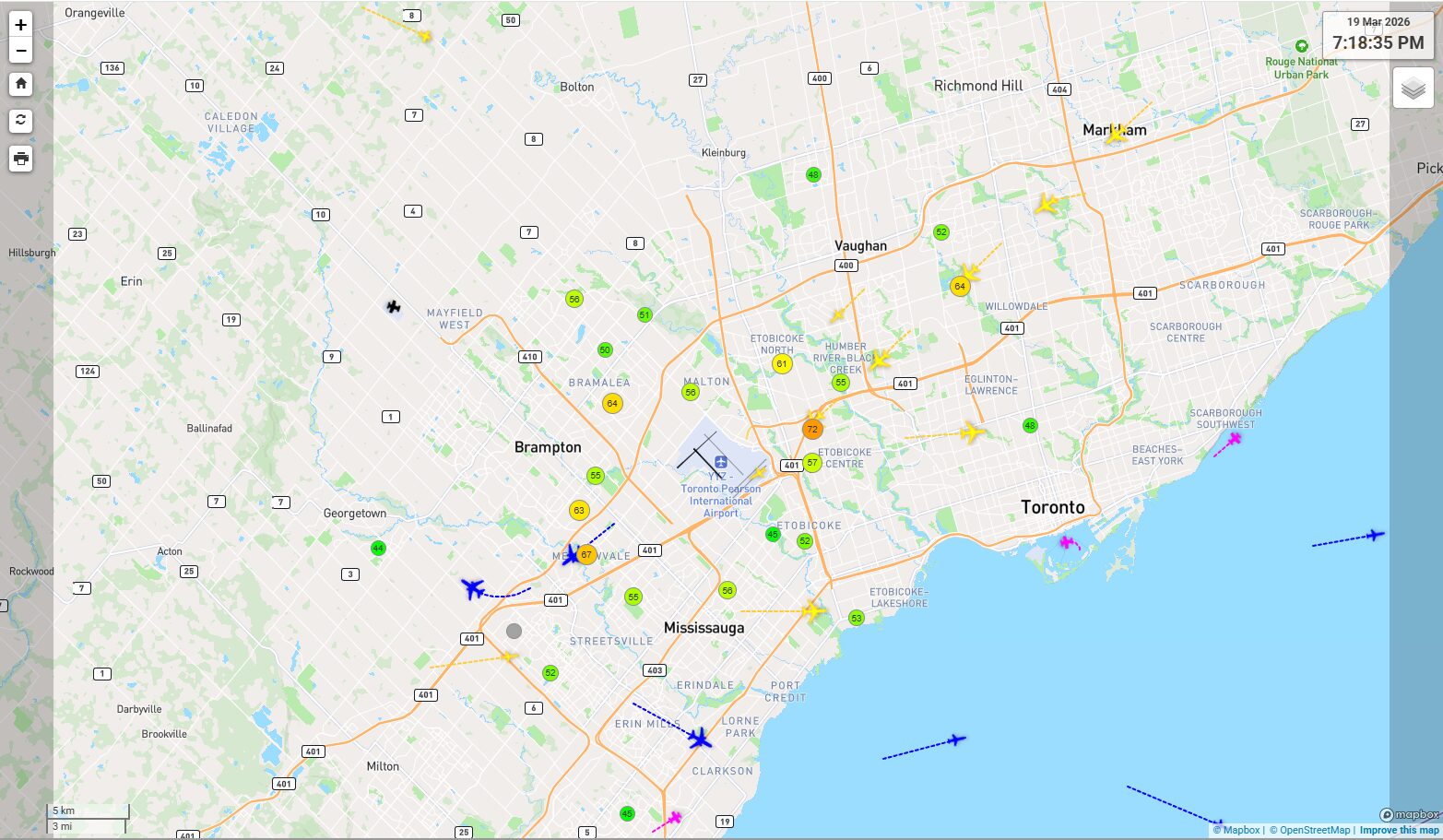
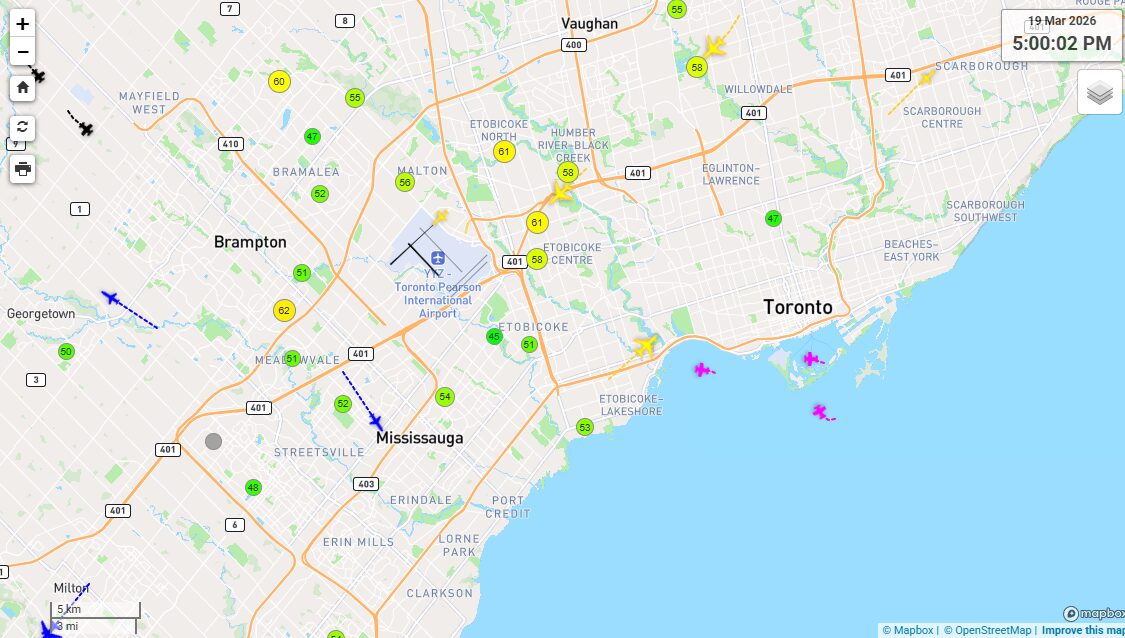
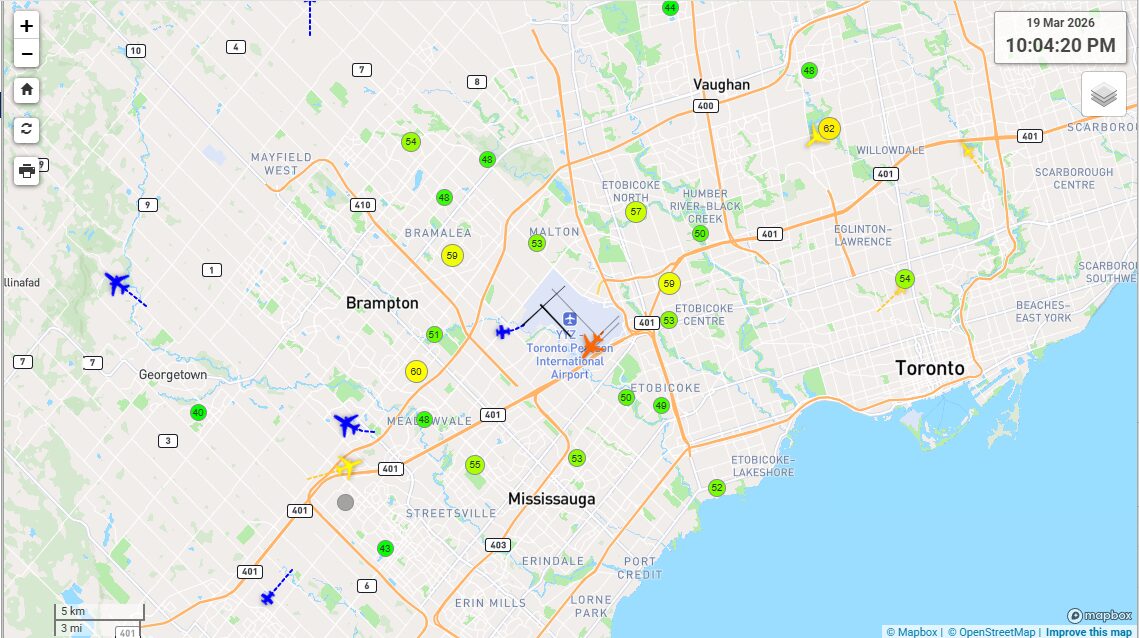
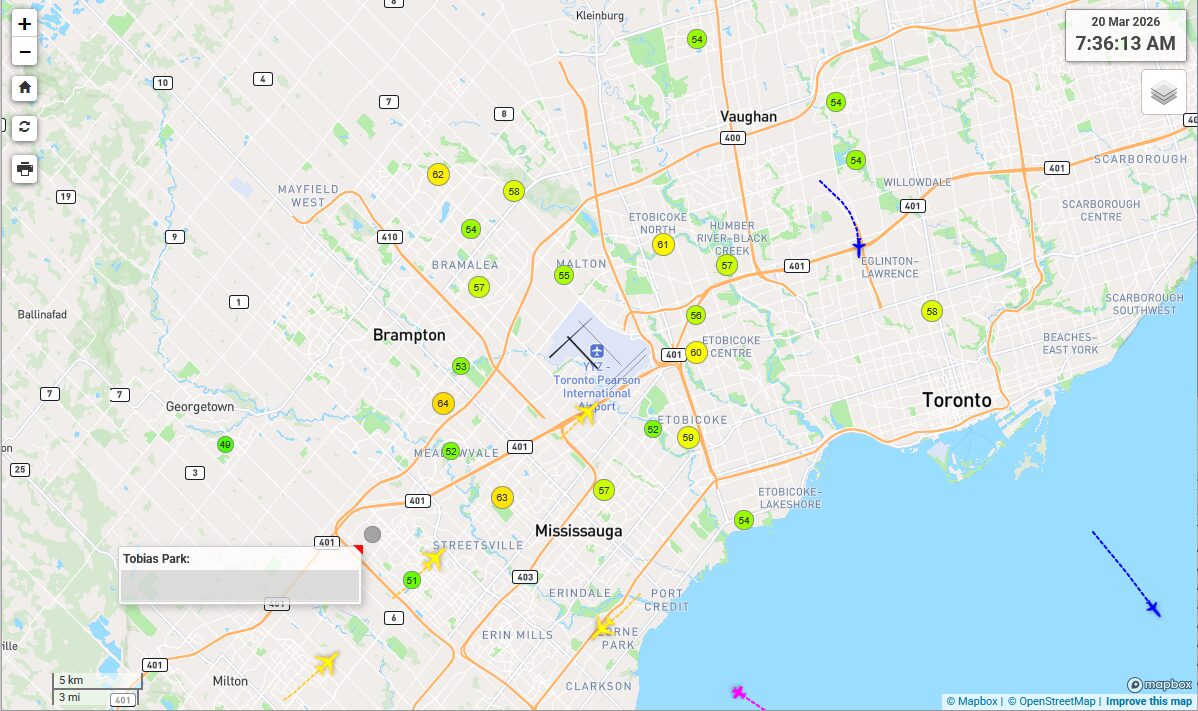
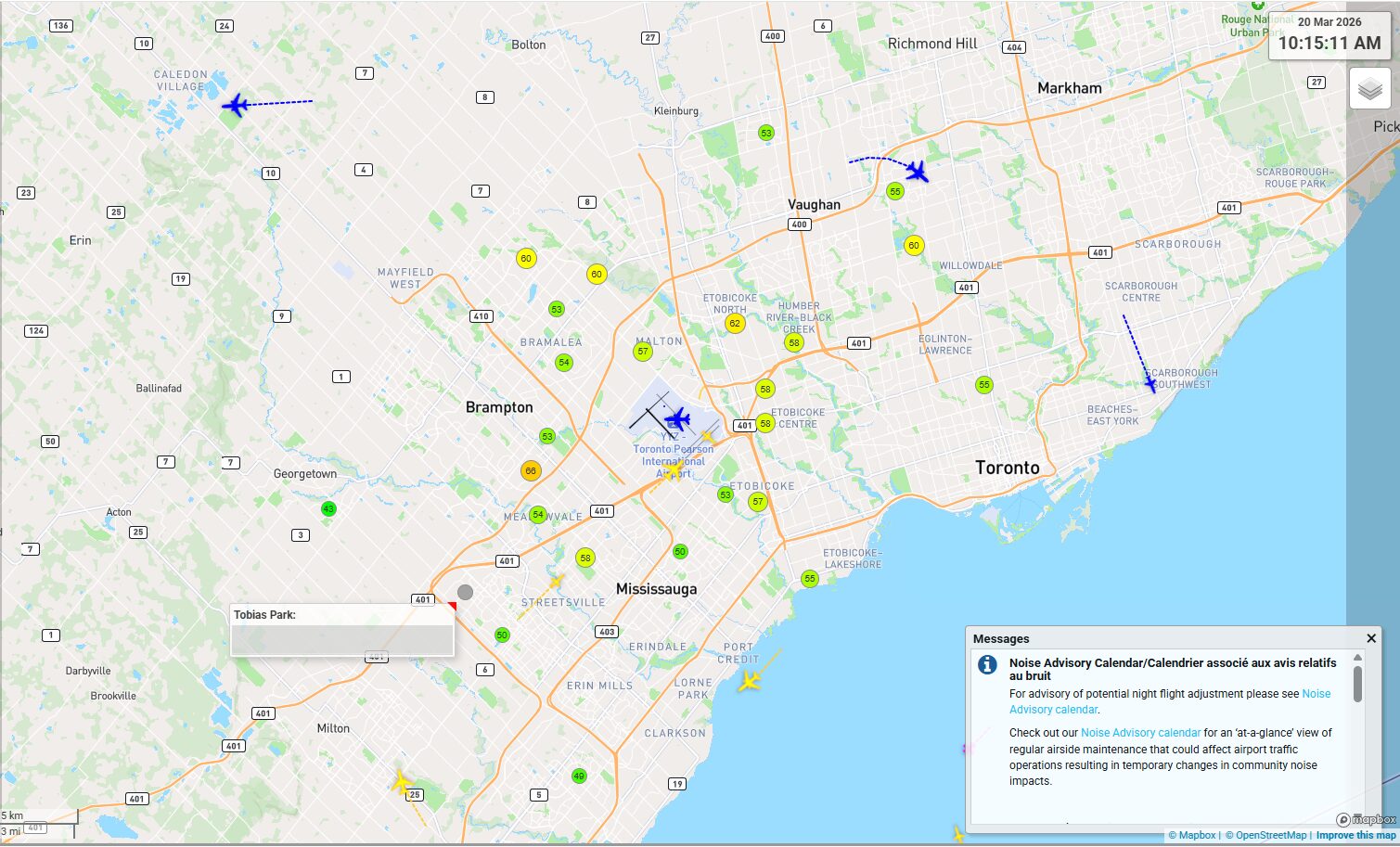
- Community screenshots documenting Tobias Park outage (March 19–20, 2026).
- March 19–20 Tobias Park outage email
- March 20, 2026 GTAA response regarding Pond Street and Tobias Park outages
Brampton Fire Station #209 NMT – continuous June 20–July 13, 2026 outage / non-reporting period
The Brampton Fire Station #209 Noise Monitoring Terminal was in a continuous outage / non-reporting period from at least June 20, 2026 until it was observed back online at some point on July 13, 2026.
Public WebTrak screenshots captured on June 20, June 21, and June 22, 2026 show the Brampton Fire Station monitor inactive or blank while surrounding NMTs continued to display readings. Because the outage is understood to have continued until July 13, these screenshots are evidence of a longer continuous reporting failure, not separate isolated events.
The exact start time and exact restoration time remain unknown. Based on the available observations, the outage lasted approximately 23 days, subject to GTAA confirmation. PAA has asked GTAA to confirm when the monitor went offline, why it stopped reporting, whether any noise data were lost, when service was restored, and whether the outage will be publicly disclosed.
A continuous multi-week outage or non-reporting period at a published NMT creates a serious gap in the environmental record for the affected community.
The later observation that the monitor was back online does not resolve the accountability problem. Without a public outage log, the public still cannot determine the exact period affected, whether missing records were recovered, or whether the gap was accounted for in GTAA’s official noise statistics.
When surrounding monitors continue reporting but one monitor remains blank or inactive, the public has no way to know whether the missing record is excluded, reconstructed, corrected, or silently absorbed into GTAA’s reporting system.
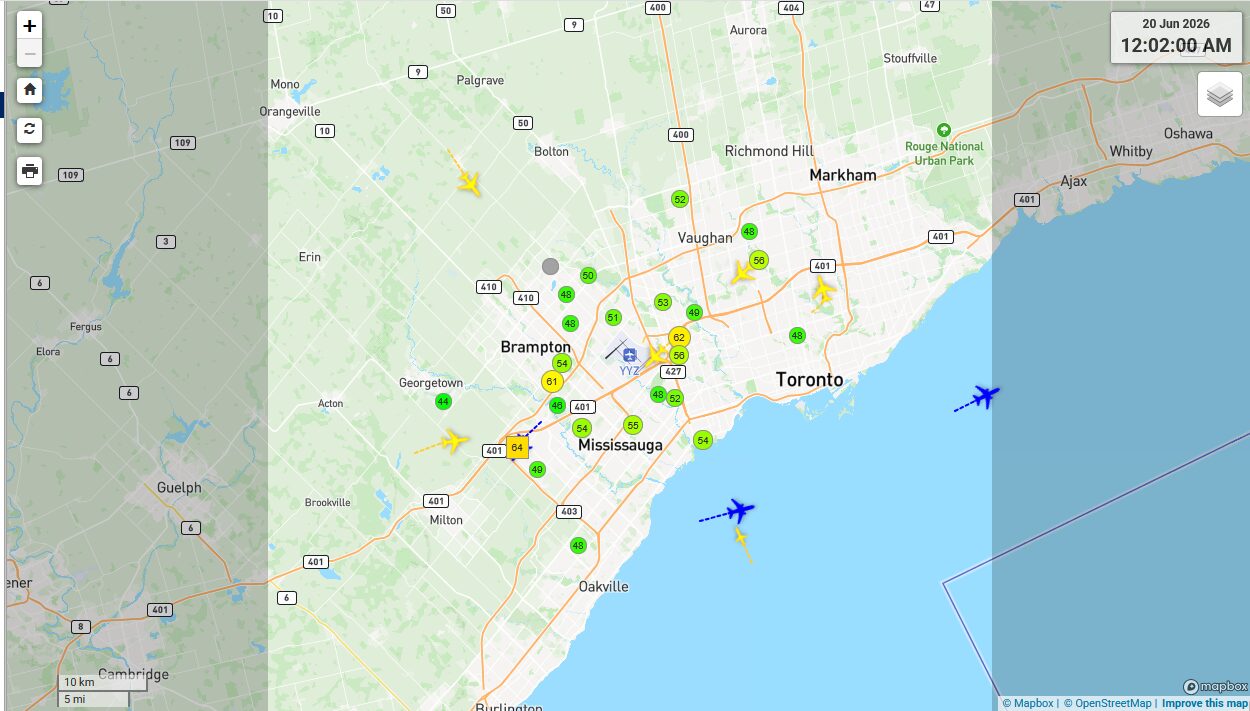
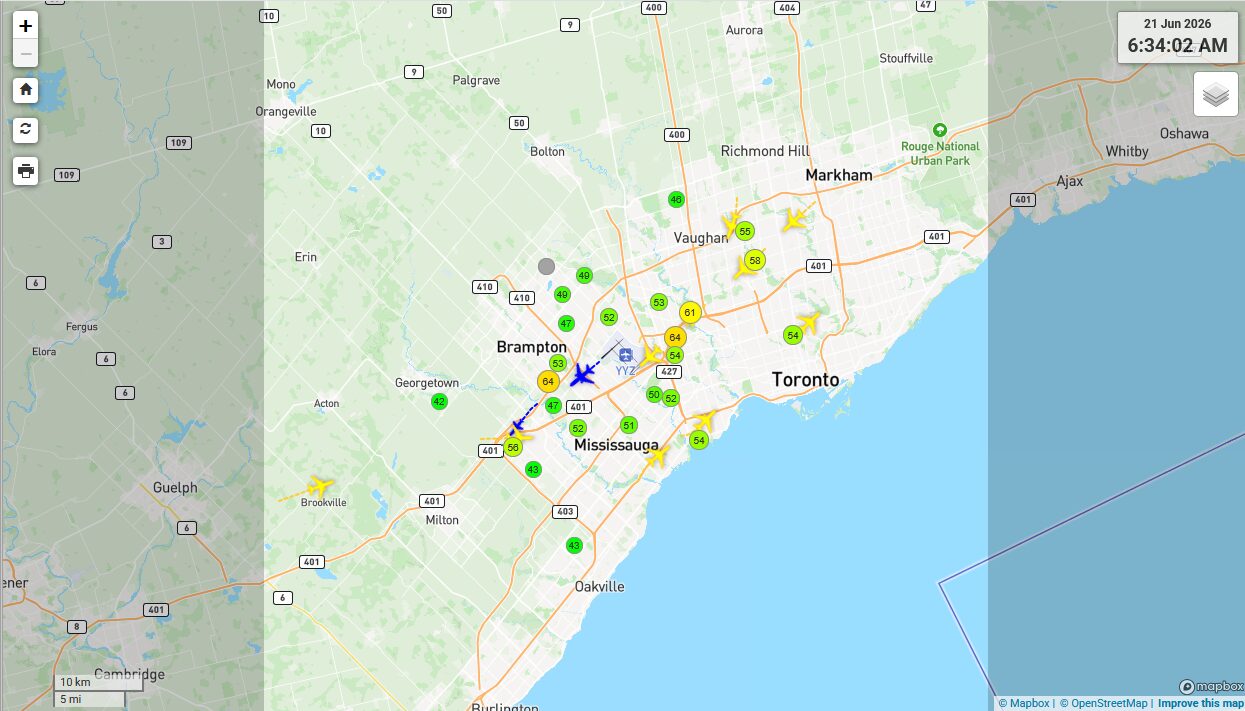
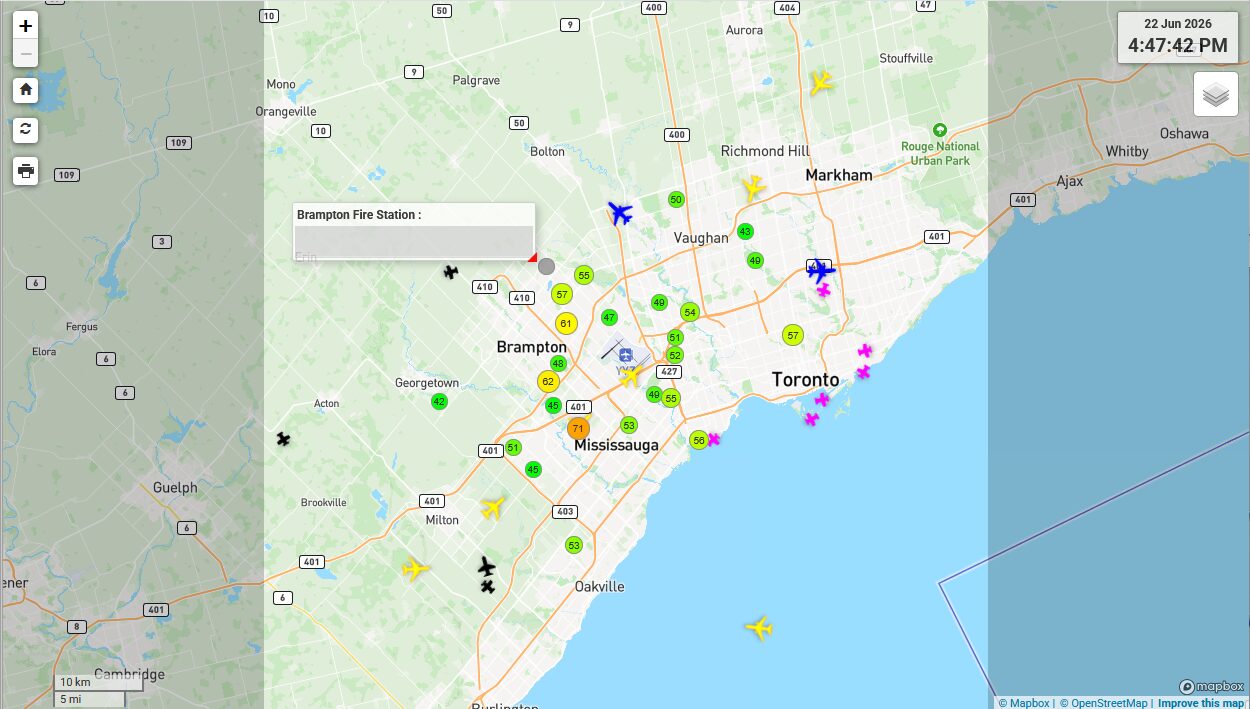
- Community screenshots documenting Brampton Fire Station #209 NMT appearing offline or not reporting on June 20, June 21, and June 22, 2026.
- Community monitoring indicates the outage / non-reporting period was continuous from at least June 20 until the monitor was observed back online at some point on July 13, 2026.
- PAA correspondence placed the incident on the record with GTAA and requested confirmation of the cause, duration, restoration status, data consequences, and public disclosure.
System-wide NMT outage – March 23, 2026
On March 23, 2026, the public noise monitoring interface displayed an apparent system-wide loss of NMT data, with all published monitoring terminals shown offline simultaneously during an active period of flight operations.
Sequential screenshots captured at approximately 13:05, 16:45, 17:00, and 18:00 show all NMT locations rendered as grey (non-reporting), while aircraft activity remained visible on the map. Based on the publicly available interface, the monitoring network was not providing published NMT data during this period.
The duration, cause, and scope of this apparent outage are unknown. No public notice or explanation was observed on the monitoring interface at the time.
A simultaneous loss of all published monitoring terminals indicates a system-level failure rather than an isolated monitor outage. When the entire network is unavailable during active operations, the public record contains no independent measurement of aircraft noise exposure for that period.
In the absence of published outage logs, uptime statistics, or timely disclosure, it is not possible to determine how frequently such system-wide interruptions occur or whether the missing data is accounted for in official reporting.
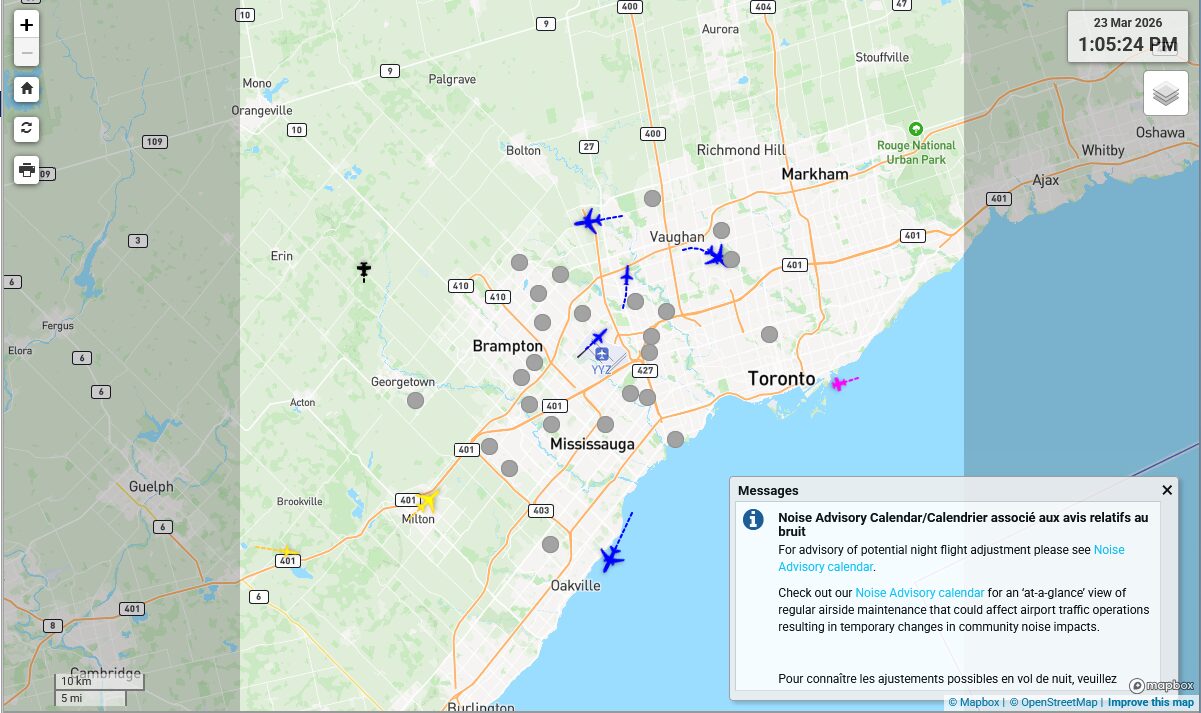
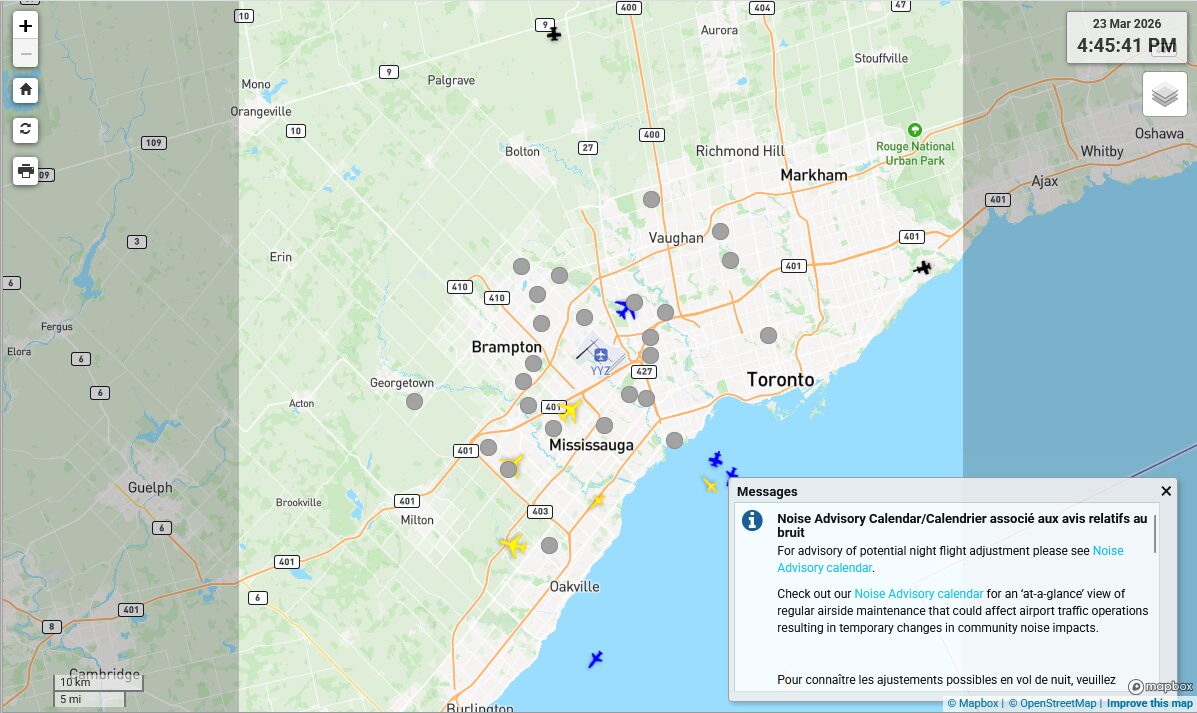
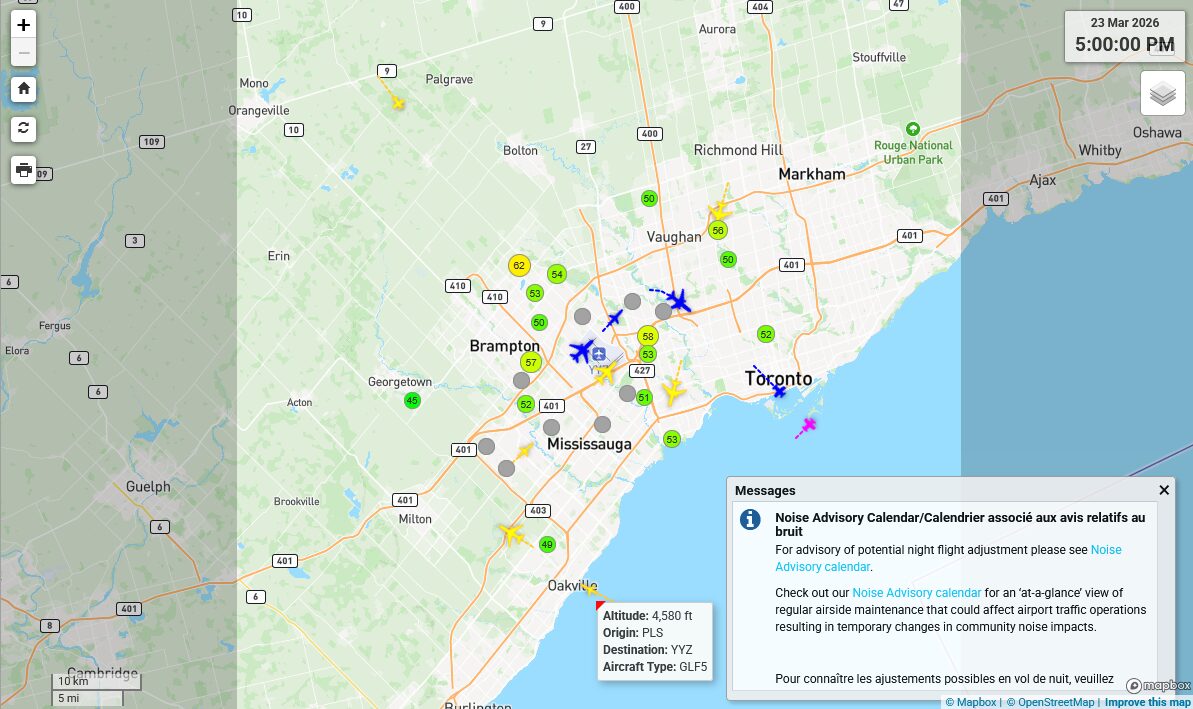
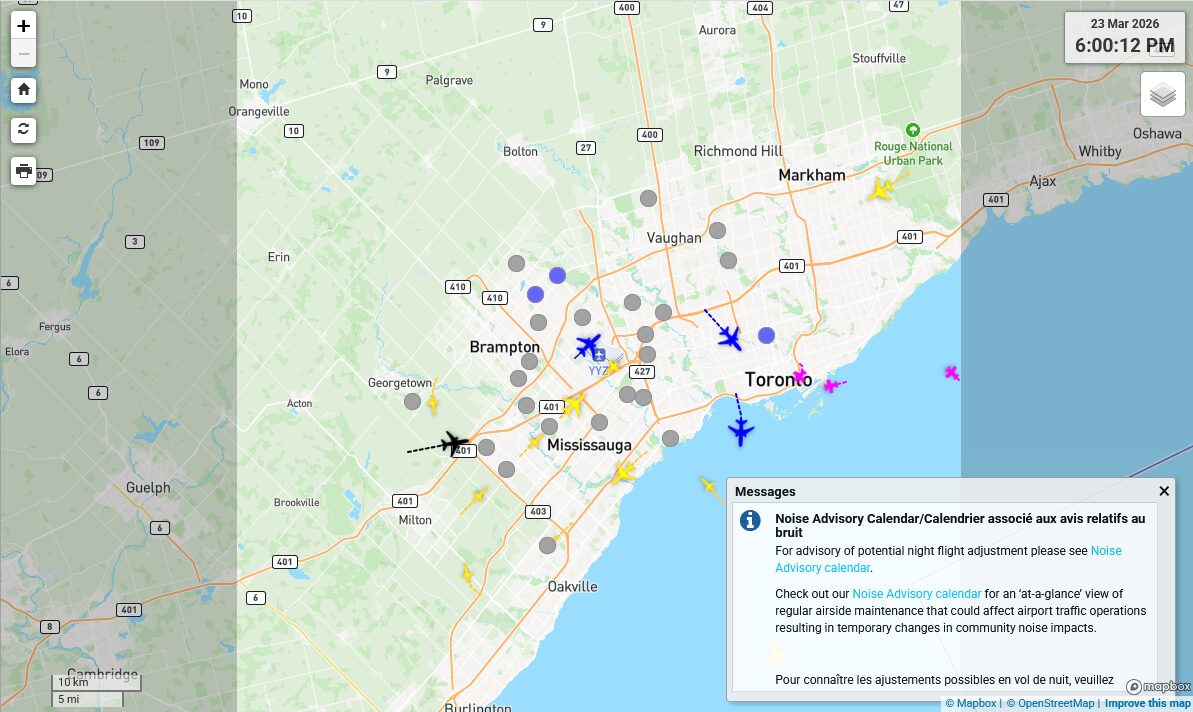
- Sequential community screenshots documenting the apparent system-wide outage on March 23, 2026.
- Aircraft activity remained visible on the public interface while all NMTs were shown as non-reporting.
Acacia Avenue / Acacia Park NMT – Evidence Summary
- Emails documenting outages beginning in 2023 and continuing in subsequent years.
- Known long-duration outage of approximately three months in 2023.
- Additional periods where local residents report the monitor as “flat-lined” while aircraft were clearly audible overhead at night.
- Repeated community attempts to obtain explanations and outage logs, with no detailed public accounting of downtime or reconstructed data.
Published Acacia Park noise data (Pearson Accountability Alliance)
- Acacia Park Noise Monitor – 2025 summary page (monthly PDFs + XLSX datasets)
- Acacia Park Noise Monitor – 2026 overnight noise audits (ongoing dataset)
Together, these datasets provide a continuous, independently compiled record of overnight aircraft noise exposure in a community directly under Pearson flight paths, including periods during which questions have been raised about the reliability of the official monitoring network.
How Pearson’s NMTs count “noise events”
On the GTAA’s own description, a noise event at an NMT is only captured when two conditions are met:
- The sound level exceeds a threshold (65 dBA by day, 60 dBA at night); and
- The sound level stays above that threshold for at least five consecutive seconds.
If either condition is not met — for example, a very loud but brief overflight, or repeated peaks just below the threshold — the event may be invisible in GTAA’s statistics, even if residents experience it as highly disruptive in their bedrooms at night.
GTAA’s own 45 dB harm threshold
In its official Restricted Hours Operating Policy (Version 4.1, May 29, 2019), the GTAA states that, during the restricted hours, it works with NAV CANADA to maintain flight procedures that “minimize the number of community residents that are overflown at a decibel rating above 45 dB”. In other words, GTAA itself treats 45 dB as the level beyond which nighttime aircraft noise exposure must be minimized for residents.
Yet in neighbourhoods such as Acacia Park, independently compiled data from the Acacia noise monitor show repeated nighttime events between 75 and 80 dB, and sometimes higher. On a logarithmic scale, an 80 dB event is perceived as more than 10 times louder than a 45 dB event.
How GTAA uses NMT data to compare “aircraft” vs “community” noise
In addition to WebTrak and ANOMS, GTAA publishes interactive dashboards that claim to show how aircraft noise compares to “community” or “ambient” noise.
On these dashboards, the bars for “community” noise are often shown as equal to or higher than the bars for “aircraft” noise. These comparisons rely entirely on the integrity of the NMT monitoring network.
When monitors are stuck, degraded, or offline, those comparisons become difficult to verify independently. This is especially significant because the same operator that controls the aircraft operations also controls the monitoring network, the thresholds, and the dashboards used to present the results.
Unexplained halt in GTAA noise reporting
The GTAA publishes quarterly “Aircraft vs Community Noise” reports through its public noise-reporting portal. As of March 2026, the most recent data visible on that dashboard appears to be from Quarter 4 of 2024.
No reports for 2025 or 2026 appear to have been published on the public portal.
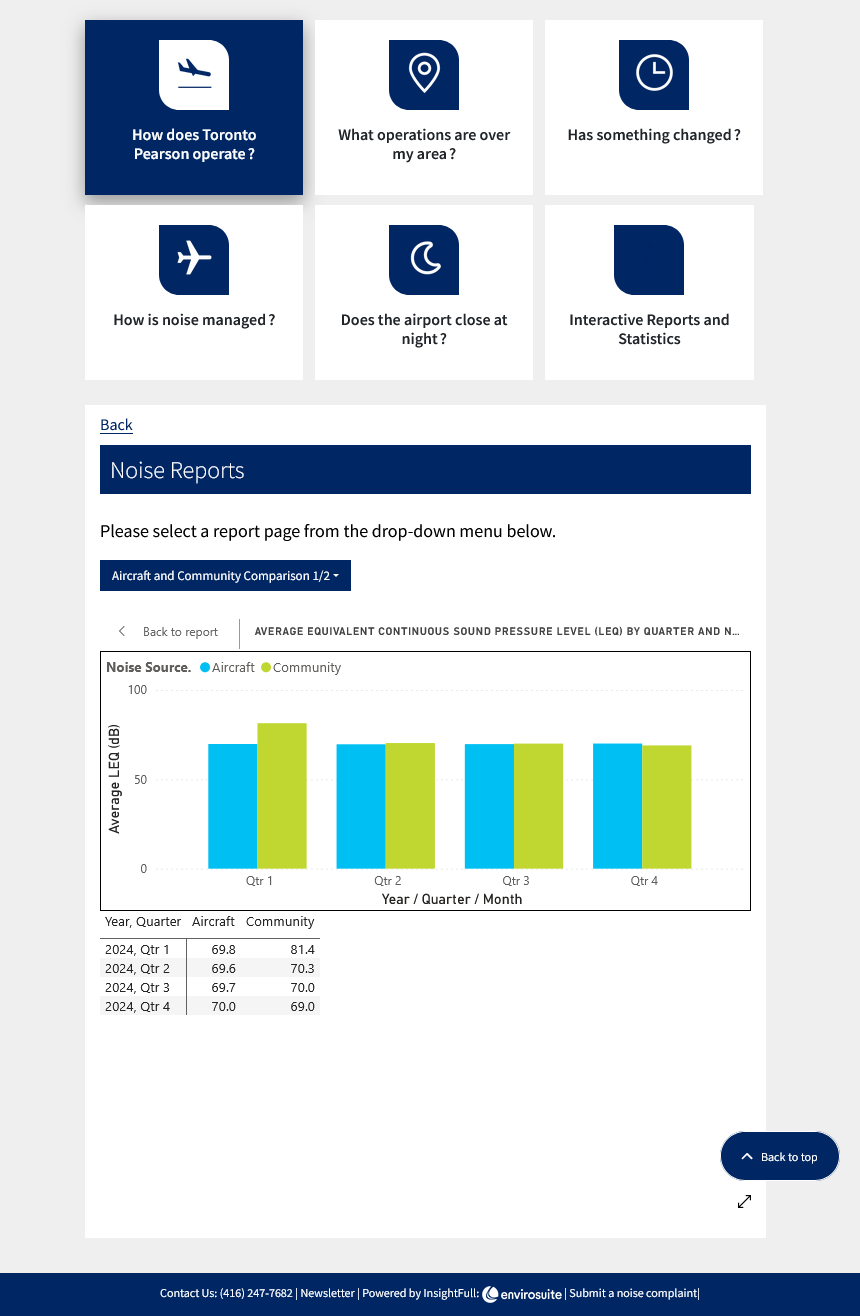
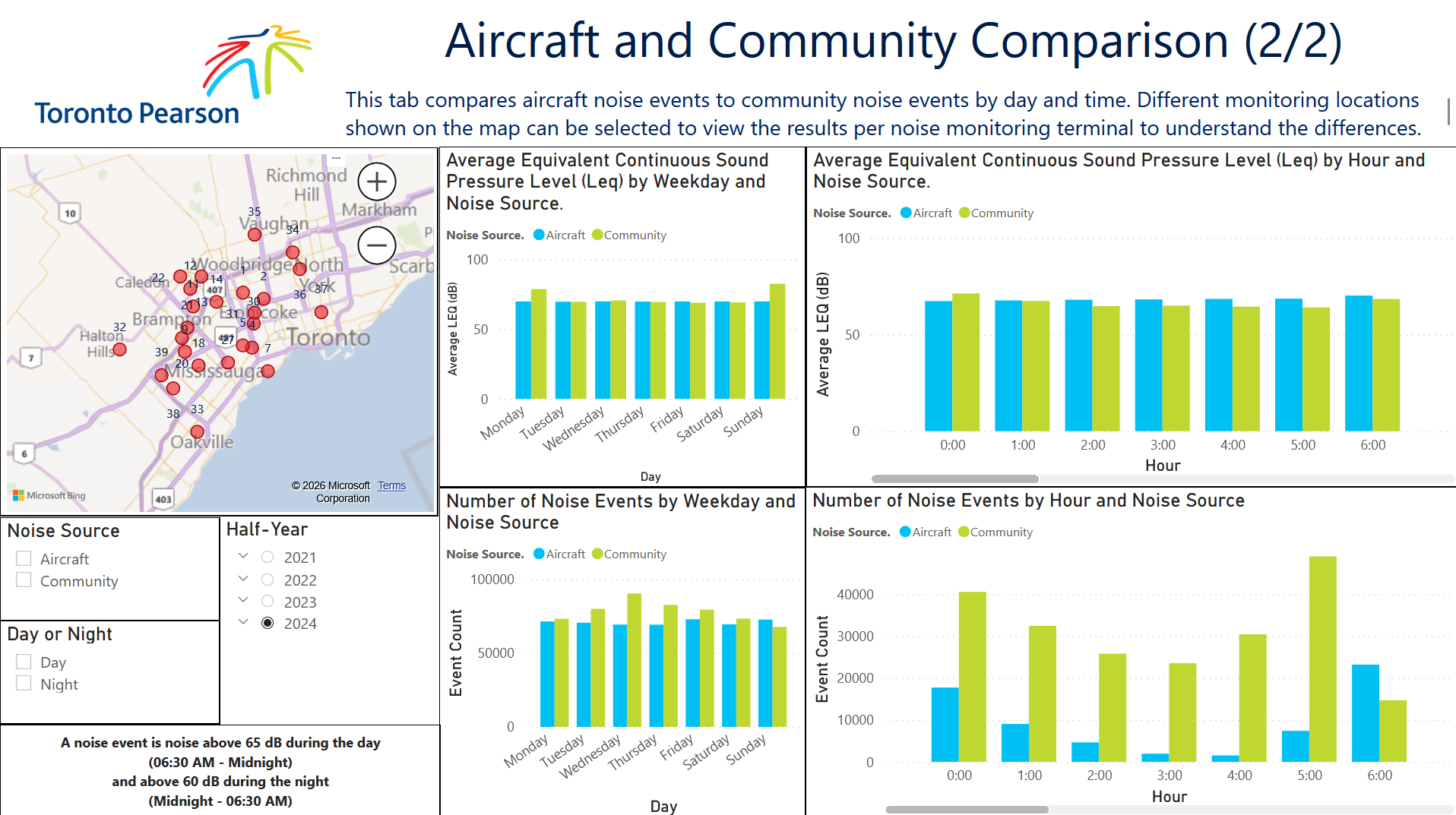
As documented elsewhere on this page, the public monitoring system has shown signs of unreliability, including a ~22-day outage of the Pond Street NMT, an additional Pond Street outage on March 15–16, 2026, a March 19–20 Tobias Park outage, the continuous June 20–July 13 Brampton Fire Station #209 non-reporting period, and a ~20-day period of fixed readings at the Marvin Heights monitor.
Despite these issues, GTAA does not publish NMT uptime statistics, outage logs, or performance metrics.
It is therefore unclear why the quarterly reports appear to have stopped after 2024, or whether the gap is related to technical, operational, or reporting changes within the monitoring system.
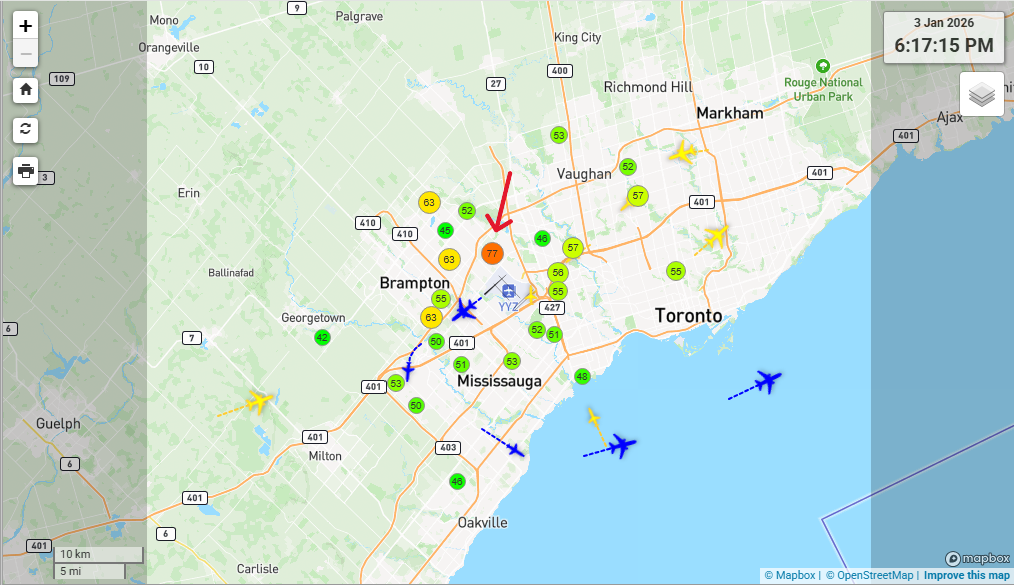
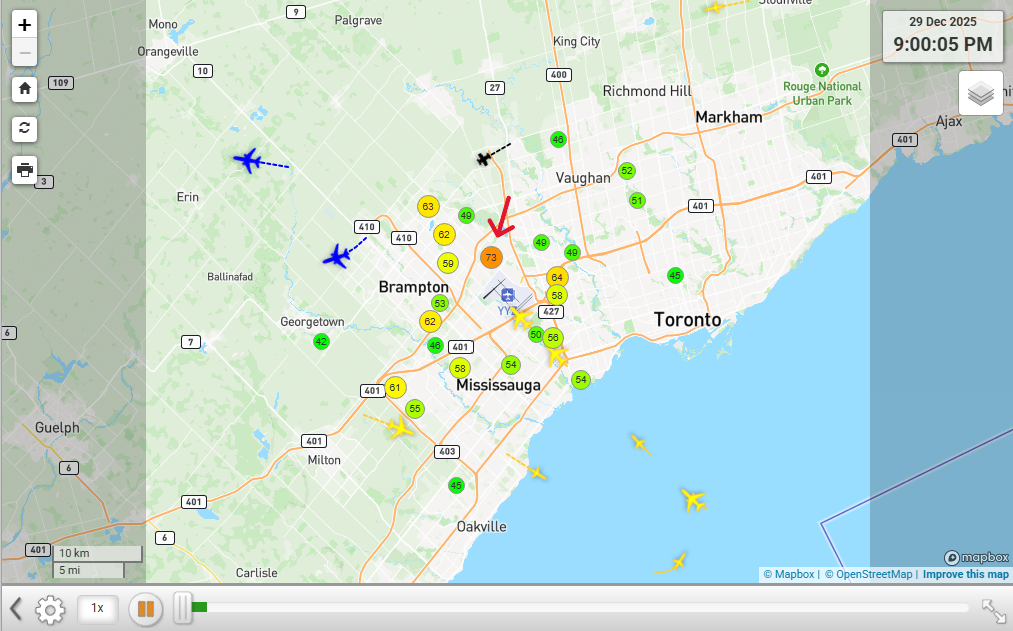
Examples: WebTrak views – Marvin Heights Public School monitor
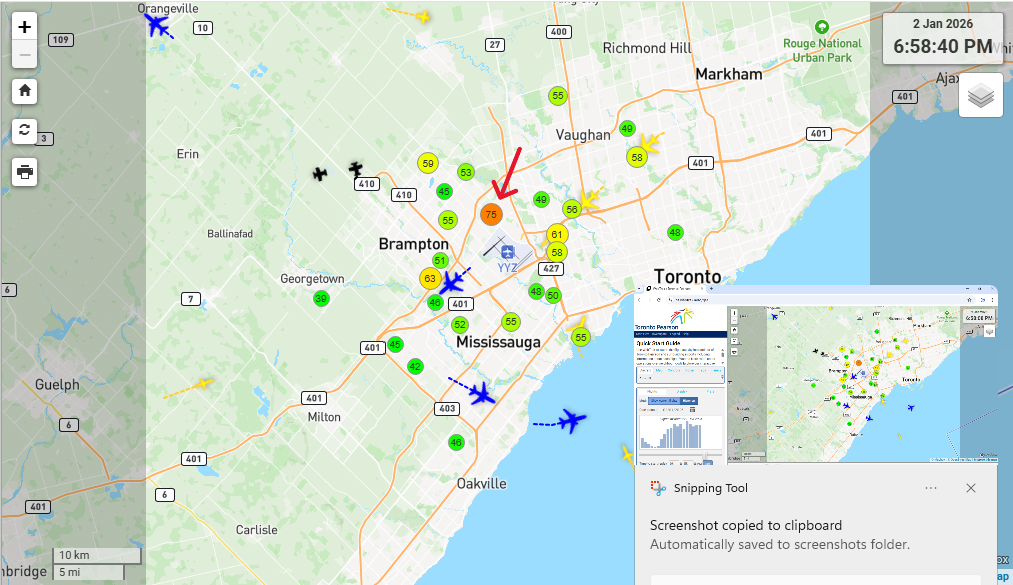
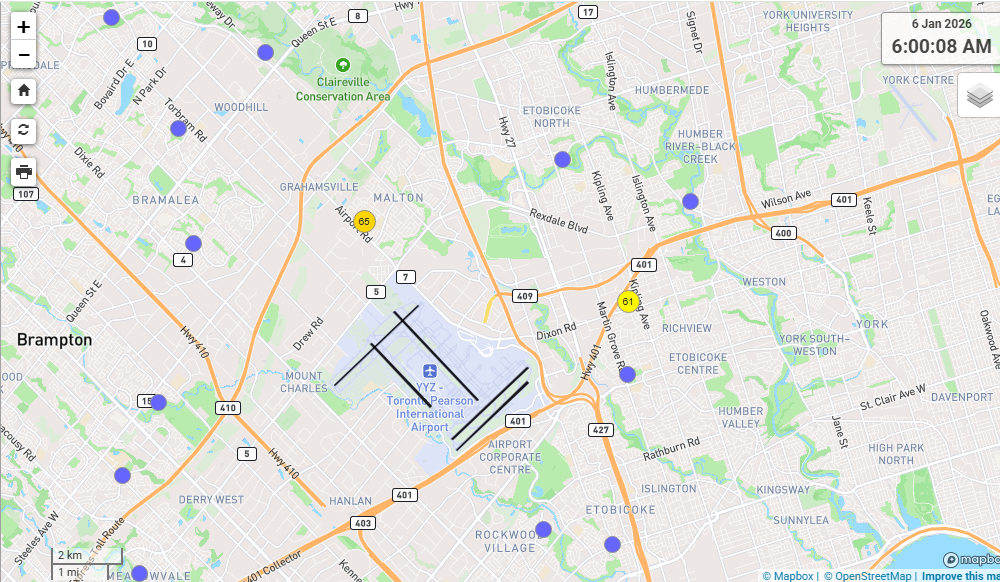
The screenshots below show WebTrak views captured between December 29, 2025 and January 10, 2026. They are part of a community-maintained record of Marvin Heights Public School NMT behaviour that extends from 2023 onward.
- Locked at abnormally high values, starting around 65 dB and ratcheting upward day after day into the high 70s, even when aircraft were distant;
- Not reacting to runway changes or traffic load, unlike neighbouring monitors;
- Staying at these inflated “background” levels for roughly three weeks, with no return to realistic community readings during the period observed; and
- No public notices from GTAA or NAV CANADA about the malfunction or data-quality issue.
This behaviour is consistent with a malfunctioning or stuck monitor — a serious issue for a system used to justify GTAA’s “community vs aircraft noise” comparisons.
Supporting documents for this section
- GTAA Restricted Hours Operating Policy v4.1.1 (PDF) — GTAA policy that acknowledges the need to minimize residents’ exposure above 45 dB at night.
- Sanitized 45 dB notification letter (PDF)
- ATI request to Transport Canada – NMT outage and reliability records (PDF)
- Joint NAV CANADA / GTAA request – NMT uptime and outage logs (PDF)
- GTAA response refusing disclosure of NMT performance metrics and system-level data (PDF)
- February 24, 2026 email to GTAA regarding NMT reliability issues (PDF)
- March 9, 2026 follow-up email to GTAA regarding Pond Street still offline (PDF)
- March 16, 2026 email to GTAA documenting Pond Street outage (PDF)
- March 19, 2026 email to GTAA documenting Tobias Park outage (PDF)
- June 20, 2026 Brampton Fire Station #209 NMT offline / non-reporting screenshot
- June 21, 2026 Brampton Fire Station #209 NMT offline / non-reporting screenshot
- June 22, 2026 Brampton Fire Station #209 NMT offline / non-reporting screenshot
- July 13, 2026 community observation that Brampton Fire Station #209 NMT was back online at some point.
Why NMT uptime matters for health and accountability
When monitors are offline, every missed night becomes a blank in the official record. Yet the aircraft still fly, and the noise still enters people’s homes.
When monitors are down, the harm is still real — but the data disappears. This systematically advantages the airport operator and disadvantages the residents, workers, and public-health systems that bear the cost.
Separate evidence documenting outages, missing tracks, and reporting anomalies affecting Toronto Pearson’s public flight-tracking portal:
Take Action: Demand an Independent Audit
The noise monitoring system is opaque, self-administered, and not independently verifiable by the public. Residents can use this page to email the Minister of Transport, copy their MP, and also notify their municipal council and local Board of Health.
Step 1: Turn this evidence into a formal record
Use the form below to generate a letter you can adapt for MPs, councils, Boards of Health, or media. You can copy the text or open it directly in your email program.
Turn This Evidence Into a Formal Record
Generate a formal letter you can adapt for MPs, councillors, ombuds, unions, or media.
Step 2: Where to send this evidence
Use the tools below to send this evidence to federal, provincial, municipal and public-health decision-makers.
Knowledge Is Power — Join the Alliance
When institutions control the information, communities lose their voice. By joining the Pearson Accountability Alliance, you gain access to facts, evidence, and tools that help you and your neighbours push for real accountability.
Evidence documents cited on this page
- GTAA Restricted Hours Operating Policy v4.1.1 (PDF)
- Sanitized GTAA 45 dB letter (PDF)
- ATI request to Transport Canada re: NMT outage and reliability records (PDF)
- Joint NAV CANADA / GTAA NMT failures correspondence (PDF)
- GTAA response refusing disclosure of NMT performance metrics and system-level data (PDF)
- February 24, 2026 email to GTAA regarding WebTrak and NMT issues (PDF)
- March 9, 2026 follow-up email to GTAA regarding Pond Street still offline (PDF)
- March 16, 2026 email to GTAA documenting Pond Street outage (PDF)
- March 19, 2026 email to GTAA documenting Tobias Park outage (PDF)
- June 20, 2026 Brampton Fire Station #209 NMT offline / non-reporting screenshot
- June 21, 2026 Brampton Fire Station #209 NMT offline / non-reporting screenshot
- June 22, 2026 Brampton Fire Station #209 NMT offline / non-reporting screenshot
For regulators, investigators, and auditors
A structured archive of noise-monitor outage emails, screenshots, dashboard gaps, and ANOMS/WebTrak discrepancies is available on request.
Please contact info@pearsonaccountabilityalliance.org for access to the full evidentiary package.
PAA’s position
Pearson operates on federal land under a Ground Lease with Transport Canada. After years of unresolved NMT failures, missing outage logs, refusal to disclose performance metrics, repeated public reporting gaps, and the newly documented continuous June–July 2026 Brampton Fire Station #209 NMT failure, it is no longer credible for the federal landlord to look away.
Pearson Accountability Alliance
Independent Environmental & Public Health Research for Toronto Pearson Communities.